Slurpee Machine Serenade: Inside the Chill-Wave Producers Who Live at the 7-Eleven
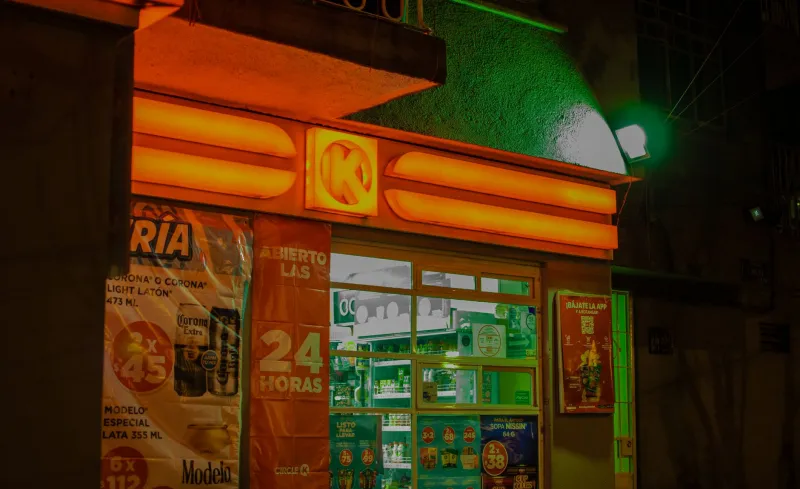
Somewhere in America right now, a convenience store is open. The door chime just triggered. A refrigerator case is humming in the key of F. The Slurpee machine is cycling through its slow, churning rhythm, and the overnight cashier is having a half-awake conversation with a guy buying energy drinks and scratch tickets. It sounds like nothing. It sounds like everything. It sounds, to a growing number of chill-wave and ambient producers, like the perfect foundation for a record.
The 24-hour convenience store is having a serious moment in underground electronic music, and it's not ironic. These producers aren't slumming it for aesthetic points. They're genuinely convinced that the sonic environment of a late-night gas station mini-mart is one of the richest, most emotionally complex acoustic spaces in American life — and their music is starting to back that claim up.
The 3am Sound Nobody Talks About
Let's start with what's actually happening acoustically inside one of these places. The fluorescent lighting hums at a frequency tied to the electrical grid — 60Hz in the US, with harmonics that stack up into the audible range in ways that vary depending on the age and condition of the fixtures. Older tubes produce a warmer, more complex buzz. Newer LED retrofits have their own digital shimmer. Both are usable.
The refrigeration units are the big story, though. A wall of glass-door beverage coolers running simultaneously creates a layered drone that shifts constantly as compressors cycle on and off. Each unit has its own pitch, its own rhythm, its own personality. "It's basically a generative ambient piece that's always playing," says Deja Fontaine, a Houston-based producer who records ambient and chill-wave material under the alias Soft Margin. "The store doesn't know it's making music. But it absolutely is."
Fontaine started recording convenience store ambience about two years ago after noticing that a particular 24-hour shop near her apartment had a refrigerator bank that droned in a way that felt almost orchestral. She went back with a portable recorder and spent an hour capturing different zones of the store. What she got was the foundation of her most-streamed release to date.
Door Chimes and Register Beeps as Percussion
Beyond the drones, the rhythmic elements available in a convenience store are surprisingly deep. The door chime — that two-note or four-note alert that triggers every time someone enters — is an obvious one, but producers are finding ways to use it that go well beyond simply dropping it into a track. Pitch-shifted down and reversed, a door chime becomes an eerie atmospheric pad. Chopped and rearranged, it becomes a melodic motif.
The point-of-sale system has its own percussive vocabulary: the beep of items being scanned, the double-beep of a coupon being applied, the longer tone of a card reader completing a transaction. Layer enough of these together and you've got something that sounds like a degraded drum machine — familiar but slightly alien.
"I spent a night just recording the register area," says Kwame Osei, a Philadelphia producer who makes lo-fi beats under the name Corner Light. "The cashier was cool about it once I explained what I was doing. What I got was this whole rhythmic environment — the beeps, the receipt printer, the occasional coin drop, the cooler doors opening and closing in the background. I didn't have to do much to it. It was already a beat."
The Slurpee Machine Is an Instrument
No conversation about convenience store sound design is complete without addressing the Slurpee machine. These devices — or their generic equivalents — produce a layered, evolving mechanical sound that has no real analogue in the synthesizer world. There's the motor hum, the slow rotation of the frozen drink cylinders, the occasional gurgle of the syrup-and-ice mixture, and the high-pitched whine that kicks in when the consistency gets too thick and the machine adjusts.
Recorded up close, it's genuinely fascinating. Producers describe it as sounding like a broken synthesizer that's figured out how to self-repair in real time. "It modulates," says Fontaine. "The pitch and texture change constantly based on what the machine is doing internally. If you record fifteen minutes of it, you have fifteen minutes of unique, non-repeating texture. That's incredibly valuable in ambient production."
The practical applications range from using short slices as pad layers to recording extended sections and using them as the textural bed for an entire track — letting the Slurpee machine essentially perform the arrangement while other elements are layered on top.
The Emotional Register of Late-Night Retail
Here's where the trend gets philosophically interesting. The producers who are most invested in convenience store sampling aren't just talking about it as a sound design exercise. They're talking about it as emotional storytelling.
The 24-hour convenience store occupies a specific psychological space in American culture. It's the place you go when you're up too late for reasons you'd rather not explain. It's where the night shift workers and the insomniacs and the people driving home from something intersect. It has a particular quality of light and sound that exists nowhere else — simultaneously mundane and slightly surreal.
"There's a loneliness to those spaces that isn't sad, exactly," says Osei. "It's more like solitude. Everybody in there at 3am is in their own world. The sounds reflect that. It's busy enough to feel alive but quiet enough to feel like the rest of the world has paused."
That emotional quality maps perfectly onto chill-wave as a genre, which has always been interested in the aesthetics of late-night urban isolation. The difference is that previous generations of chill-wave producers were constructing that feeling synthetically. These artists are capturing it live, at the source.
How to Actually Do This
For producers curious about trying this approach, the logistics are simpler than they might seem. A decent portable recorder — a Zoom H5 or H6 is the standard recommendation in these communities — and a pair of small omnidirectional microphones is enough to capture most of what makes these environments interesting. The key is time. Showing up once and recording for twenty minutes gets you surface-level material. Showing up repeatedly, at different hours, in different weather conditions, gets you something genuinely deep.
It also helps to build relationships with the staff. Overnight workers are often the most interesting part of the sonic environment anyway — their conversations, their music choices, the way they move through the space — and having their buy-in makes the whole process easier and more productive.
"The best stuff I've recorded happened because a cashier started talking to me about what it's like to work nights," says Fontaine. "That conversation, recorded ambient under the store sounds, became the emotional core of an entire track. You can't plan for that. You just have to show up and let it happen."
The convenience store never closes. Neither does the recording session.