8 Tracks Built From Kitchen Chaos That Prove the Best Studio Is a Commercial Kitchen
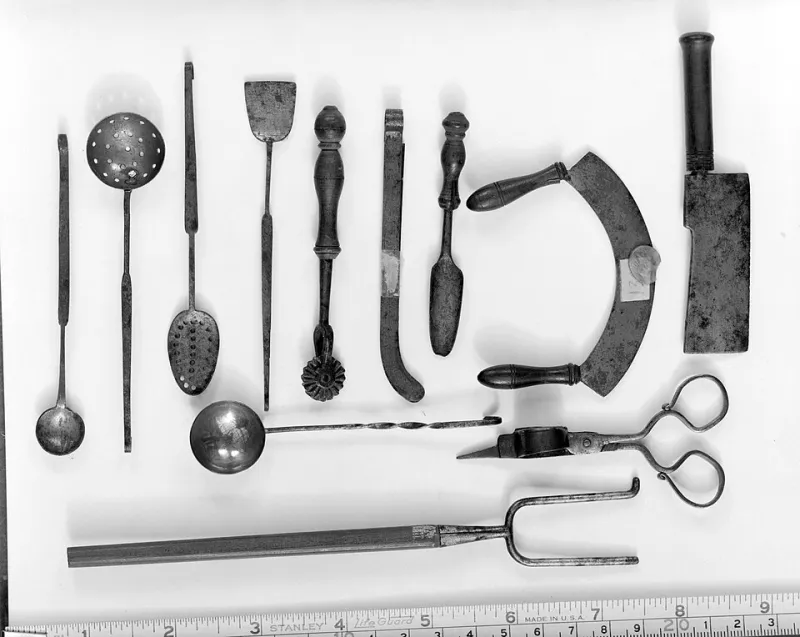
Photo: Unknown, CC0, via Wikimedia Commons
Forget the Foley stage. Forget pristine sample packs. A growing crew of experimental and electronic producers has figured out that the most interesting percussion section in America is already working a double shift — and it smells like garlic and cast iron.
The commercial kitchen has always been its own kind of performance. Line cooks operate with the precision and timing of jazz musicians, and the sonic environment they create — the layered sizzle of a flat-top grill, the metronomic thud of knife on cutting board, the punctuating beep of ticket printers and oven timers — is, if you really listen to it, an extraordinarily complex rhythmic landscape. A handful of producers have been listening very carefully.
From Brooklyn to Austin to Portland, culinary sound sampling has quietly become one of the more exciting micro-trends in underground electronic music. We pulled together eight of the standout tracks making noise right now, talked to some of the producers behind them, and dug into what makes the kitchen such fertile ground for beat architecture.
1. "Mise en Place" — Flour + Watts
Chicago-based duo Flour + Watts spent three weekends in a friend's restaurant after closing time with a pair of Zoom H5 recorders and a very understanding chef. The result is this eleven-minute ambient-industrial piece built almost entirely from the sound of prep work: the rhythmic scrape of a bench scraper across stainless steel, the hollow knock of a stockpot lid, and what they describe as "the breathing of a walk-in cooler." The kick drum is a cast iron skillet being set down hard on a gas range. No pitch correction. No apology.
"We wanted to capture the kitchen as a machine," says the duo's Jasmine Okafor. "Not the glamorous plating moment — the unglamorous, repetitive labor that happens before that. That's where the real rhythm lives."
2. "Ticket Up" — DJ Saucepan (no, really)
The name is a bit on-the-nose, but the music isn't. This Brooklyn producer — who has worked in restaurants for over a decade and produces on the side — built "Ticket Up" around the specific sonic signature of a busy Saturday night service. The hi-hat pattern is a ticket printer. The snare is a stainless steel pan being pulled from an overhead rack. The bassline is a low-end rumble he extracted from a recording of an industrial dishwasher mid-cycle, pitched down and run through a saturator until it sounds like something between a sub-bass and a diesel engine.
"Every kitchen has its own tempo," he says. "A brunch rush sounds completely different from a dinner service. I've started thinking of every shift I work as a field recording session."
3. "Reduction" — Ama Devi
Ama Devi's approach is more melodic than rhythmic. The Portland-based producer and former culinary school student recorded the sound of liquids at different stages of reduction — the rapid, high-pitched simmer of a thin stock versus the slow, low bubble of a thickened sauce — and used those recordings as textural pads and drones beneath a sparse, melancholic beat. The track feels like watching something transform slowly. Which, of course, is exactly what a reduction is.
4. "Sheet Pan" — Vessel Noise
This one's a banger in the most literal sense. Austin producer Vessel Noise recorded himself banging sheet pans against a commercial prep table at varying velocities and angles, then spent two weeks chopping, layering, and processing those recordings into a full drum kit. The resulting track runs at 96 BPM and hits with a metallic, industrial aggression that sounds like Nine Inch Nails producing a drill track. The snare, in particular, is devastating.
"Sheet pans are underrated percussion instruments," Vessel Noise says without a hint of irony. "The resonance you get from a half-sheet pan versus a full-sheet is genuinely different. I've got a whole folder just of pan recordings organized by gauge and size."
5. "Cambro" — Soft Serve Theory
Named after the ubiquitous plastic food storage containers found in every commercial kitchen in America, this track by Philadelphia's Soft Serve Theory uses the hollow, almost wooden knock of Cambro containers being stacked and unstacked as its primary percussive element. Layered over a slow, dubby bassline, the effect is meditative rather than industrial — like a kitchen winding down at the end of a long night rather than ramping up for service.
6. "Expedite" — Mara Sol
Mara Sol's contribution to the genre is the most conceptually ambitious on this list. The New York-based producer recorded an entire service at a restaurant where a friend works as an expo — the person who calls out orders and coordinates timing between the kitchen and the floor. She then transcribed the expo's verbal calls ("86 the halibut," "fire table 12," "corner!") into a rhythmic vocal chop sequence that serves as both the lyrical content and the melodic hook of the track. It's part beat tape, part documentary, and entirely hypnotic.
"The expo is basically a human sequencer," Mara Sol explains. "They're keeping time, managing layers, making sure everything hits at the right moment. That's just production."
7. "Garde Manger" — Static Pantry
The cold station of a professional kitchen — garde manger in culinary parlance — is quieter than the hot line, and Static Pantry's track reflects that. Built from the sounds of cold prep: the crack of ice, the wet slap of proteins being portioned, the hiss of a CO2 line on a soda gun. It's the most textural and least beat-forward track on this list, landing somewhere between field recording and ambient electronica. Perfect late-night listening.
8. "Ding" — The Nightly
We saved the most fun for last. LA-based collective The Nightly constructed an entire four-minute track using nothing but kitchen timer sounds — the mechanical ding of old-school dial timers, the digital beep of modern combi ovens, the triple-tone alert of a commercial microwave — sequenced and pitched across three octaves into a melody that's somehow both annoying and completely catchy. It sounds like a ringtone designed by a Michelin-starred chef and it absolutely slaps.
Why the Kitchen Works as a Sample Source
There's a practical reason this trend is gaining momentum: kitchen sounds are legally uncomplicated. They're original recordings with no copyright entanglements, no clearance process, no label to negotiate with. In a landscape where sample clearance can kill a project before it starts, the appeal of building your entire palette from scratch — literally — is significant.
But beyond the legal math, there's something emotionally honest about kitchen-sourced music that connects with listeners who are exhausted by pristine, over-produced sounds. These recordings carry the weight of physical labor. You can hear effort in them. You can hear heat.
As DJ Saucepan puts it: "People are hungry for music that sounds like it came from somewhere real. The kitchen is about as real as it gets."
The next time your oven timer goes off, maybe don't silence it so fast. Someone out there is sampling that.