Steam, Chatter, Drop: How Coffee Shop Noise Is Becoming Lo-Fi's Most Underrated Secret Weapon
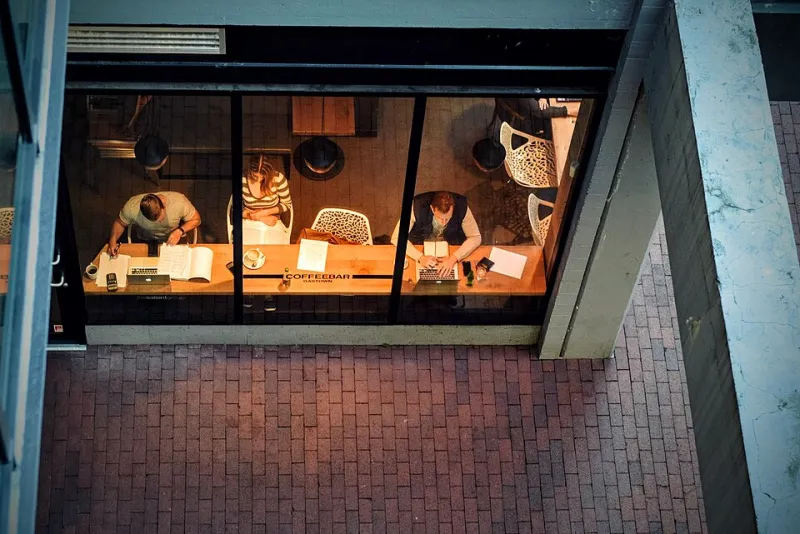
Photo: Tim Gouw punttim, CC0, via Wikimedia Commons
There's a particular kind of chaos that lives inside a busy coffee shop on a Tuesday morning. The espresso machine fires off in short, pressurized bursts. A barista calls out a name nobody in line seems to own. Milk steams into something close to white noise. Cash registers click. Chairs scrape. Someone's laptop fan hums under a conversation about literally nothing. For most people, it's just background. For a growing wave of electronic producers, it's raw material.
Welcome to the café session — not the "work from a coffee shop" kind, but the "I brought a field recorder and I'm leaving with stems" kind.
The Studio Was Always Kind of a Lie
The mythology of music production is built around isolation. Soundproofed rooms. Dead acoustic space. Controlled environments that strip out the world so the artist can build something from scratch. It's a clean concept, but it's also a little sterile — and a lot of producers have started to feel that.
"I was spending so much time in a room designed to have no personality," says Marcus Delray, a Chicago-based lo-fi and ambient producer who goes by the handle Warmfront. "And then I'd go get coffee and I'd hear all this incredible layered texture just happening naturally, and I'd think — that's the room I actually want to work in."
Delray started bringing a portable recorder to his local spot in Wicker Park about two years ago. What began as casual experimentation turned into a full production method. His last EP, Grind Cycle, was built almost entirely from café field recordings run through granular synthesis and light pitch manipulation. The espresso machine on track three? You'd probably recognize it if you knew what you were listening for. But chopped and time-stretched, it sounds like something between a Burial loop and a vintage drum machine.
What Makes Coffee Shop Audio So Usable
It's not random that producers keep gravitating toward this particular environment. Coffee shops, especially independent ones, have an acoustic profile that's genuinely hard to replicate in a studio.
First, there's the natural reverb. High ceilings, hard floors, exposed brick — all the design choices that make a café feel cool also make it bounce sound in interesting ways. You get a room sound that's warm without being muddy, present without being sharp.
Then there's the layering. At any given moment in a busy café, you've got low-frequency hum from refrigeration units, mid-range chatter from a dozen overlapping conversations, and high-end transients from cups, spoons, and register keys. That's essentially a full frequency spectrum happening organically, in real time, with no EQ.
"It's like the room is already mixing itself," says Priya Nair, a Brooklyn-based producer and sound designer who's been sampling ambient environments for the better part of a decade. "You walk in and it's already got a vibe. Your job is just to capture it without wrecking it."
Nair records in what she calls "passive sessions" — she orders her drink, finds a spot near the counter (where the machine action is densest), and lets her recorder run for anywhere from thirty minutes to two hours. No direction, no setup. Just ambient capture. Back in her studio, she'll comb through the audio looking for moments that feel rhythmically interesting or texturally unique.
"Espresso machines have this incredible percussive quality," she explains. "The tamping, the pull, the pressure release — if you catch a good sequence, it's basically a drum pattern. I've built whole tracks around a thirty-second clip from a single barista's workflow."
Lo-Fi's Natural Habitat
The lo-fi genre has always had a complicated relationship with "authenticity." Those vinyl crackles and tape hiss textures? Often synthesized or carefully applied in post. The bedroom aesthetic? Frequently a stylistic choice made in a very professional room. There's nothing wrong with that — it's production craft — but there's a growing contingent of producers who want the texture to be real.
Café recordings deliver exactly that. The imperfection is genuine. The background conversation bleeding into a kick drum hit isn't manufactured nostalgia — it's just what happened when someone ordered a cold brew at the wrong moment. That kind of uncontrolled authenticity is hard to fake, and listeners are starting to notice the difference.
Delray puts it simply: "People can feel when something was actually lived in. A coffee shop recording has that lived-in quality baked into every sample."
There's also something culturally resonant about the source material. Coffee shops are one of the few communal spaces in American life where people still sit together in public without a specific agenda. They're ambient social environments — and that ambient social energy translates into recordings that feel human in a way a lot of electronic music doesn't.
The Gear Question
You don't need to spend a fortune to do this. Most producers in this space are working with compact field recorders — the Zoom H5 and Tascam DR-40X come up constantly — or even high-quality smartphone setups with external microphone attachments. The goal isn't audiophile fidelity. Honestly, a little bit of device limitation adds character.
Placement matters more than gear. Nair recommends positioning the recorder low to the counter surface to catch the mechanical sounds of the espresso workflow without getting overwhelmed by human voice frequencies. Delray prefers corner placement to maximize room bounce and pick up the full ambient spread.
"You're not recording a concert," Nair says. "You're recording an environment. The technique is more about patience than precision."
Ethics of the Ambient Pull
It's worth flagging — and producers in this space are generally thoughtful about it — that recording in public spaces, especially ones where conversations are happening, comes with some responsibility. Most producers working with café audio are careful not to capture or use identifiable speech. The goal is texture, not content. Conversations get buried in reverb, chopped into rhythmic fragments, or filtered into unintelligibility before they ever end up in a track.
"I'm not sampling what anyone said," Delray notes. "I'm sampling the fact that people were talking. There's a difference."
Some producers go a step further and work directly with café owners to record during off-hours, getting the machine sounds and room acoustics without the ethical complexity of ambient conversation capture. Either approach works — it just depends on what kind of texture you're after.
The Next Cup Is Already a Track
There's something quietly radical about what these producers are doing. They're not just finding new sounds — they're pushing back against the idea that music production requires a purpose-built space, expensive gear, and total acoustic control. The best studio, it turns out, might just be the place where everyone already goes to think, work, and exist in public.
The espresso machine fires again. The milk steams. Someone scrapes a chair. And somewhere in the corner, a producer with a Zoom H5 and a very large cold brew is grinning, because they just caught the perfect loop.
Your morning coffee order? Already halfway to a beat.