Price Check on Aisle Banger: Why Hyperpop Producers Are Living at the Grocery Store
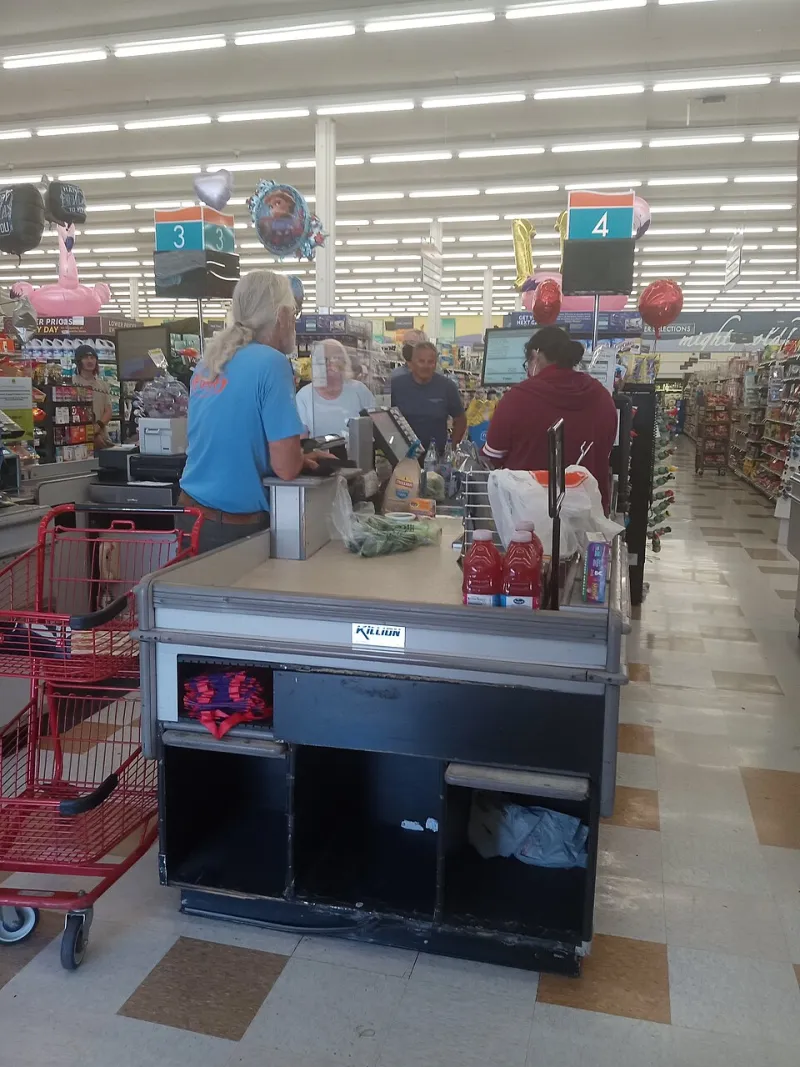
Photo: Sonny doe, CC BY-SA 4.0, via Wikimedia Commons
Walk into a busy Kroger on a Saturday afternoon and just — stop. Don't grab a cart. Don't check your list. Just listen.
There's a rhythm happening. Scanner beeps firing in stuttered clusters. A conveyor belt grinding forward in short mechanical bursts. The distant thwack of a price gun. Refrigerator units cycling on and off in low, droning waves. A PA system cutting through it all with a muffled, slightly distorted voice calling for a manager override on register six. Somewhere near the deli, a slicer is going. It doesn't stop.
To most shoppers, that's just background noise — the ambient tax you pay for cheap cereal and loyalty card discounts. To a growing number of hyperpop and experimental electronic producers, it's a sample pack that money literally cannot buy.
The Beep Is the Beat
Hyperpop as a genre has always thrived on overload. Clipped vocals, pitched-to-absurdity synths, percussion that sounds like it's being played by someone who just drank a Red Bull IV drip — the aesthetic has never been shy about maximalism. But there's a dirty secret inside a lot of those frenetic, chaotic tracks: the rhythm underneath all the glitch and grime is often surprisingly mechanical. Almost procedural.
That's where the grocery store becomes genuinely interesting source material. The checkout scanner doesn't emote. It doesn't swing. It fires at a fixed interval every single time a barcode crosses the laser, creating an almost metronomic pulse that's technically perfect but weirdly inhuman. Stack six of those beeps at slightly different pitches — because not every store's scanner is calibrated the same — and you've got a percussive layer with texture that no stock drum kit is going to replicate.
Producer and field recording obsessive Maren Solís, who releases music under the alias CARTGIRL, spent three months in 2023 doing what she calls "aisle sessions" at a 24-hour Walmart outside of Columbus, Ohio. Armed with a Zoom H5 recorder and a completely straight face at the self-checkout, she built what became her Perishable EP entirely from supermarket audio.
"The self-checkout section specifically is insane," she told us over DM. "You've got the beep cadence, but then you've also got the 'please place item in bagging area' voice — which is this weird, flattened, almost robotic female voice — and it's already processed. It already sounds like a sample. I barely had to touch it."
Controlled Chaos Has a Frequency
What makes the grocery store different from, say, a construction site or a subway platform — both of which have had their own moments in the producer field recording universe — is the density of distinct sounds packed into a relatively small, acoustically consistent space.
A construction site is loud but often monotonous. A subway gives you great low-end rumble but the sonic palette is limited. A grocery store, especially a large chain store during peak hours, is essentially a layered composition already in progress. You've got low-frequency hum from the HVAC and refrigeration. Mid-range clatter from carts, packaging, and stocking activity. High-end detail from scanners, PA announcements, and the occasional dropped can. It covers the whole frequency spectrum, and it does it in a space that's acoustically treated — not for music, obviously, but the drop ceilings and product-lined walls create a kind of natural dead room effect that producers actually love.
Brooklyn-based producer Fenn Takahashi (who goes by FENN/T on streaming platforms) described it as "the accidental anechoic chamber." He's been incorporating grocery store ambience into his productions for about two years, and his approach is less about direct sampling and more about texture layering.
"I don't always use the beep as a rhythmic element," he explained. "Sometimes I'll take ten seconds of that refrigerator hum and just stretch it out into a drone that sits under the whole track. You don't hear it consciously, but when I mute it, the track feels empty. It's doing something to the space of the mix that a synthesized pad just doesn't."
The Ambient Aisle
Beyond the percussion and texture angles, there's a whole other dimension that producers are mining: the in-store music itself.
For decades, American grocery chains have piped in a specific kind of muzak — softened pop hits, easy listening instrumentals, occasionally a weirdly upbeat cover of something you'd recognize if you could just place it. That music, playing through cheap ceiling-mounted speakers with limited frequency response, gets transformed in the process. The bass disappears. The highs get clipped. What comes out is a kind of lo-fi ghost of the original track, and layered against the natural sounds of the store, it creates something genuinely eerie.
Solís called this phenomenon "the haunting" in her production notes for Perishable. "There's a track on the EP where I recorded a Mariah Carey song playing over the intercom at like 2 a.m. when the store was basically empty," she said. "It sounds nothing like Mariah Carey. It sounds like something playing from another dimension. I pitched it down another step and it became the centerpiece of the whole record."
The copyright implications of sampling recognizable music — even in degraded, heavily transformed form — are real and worth noting. Most producers working in this space are careful to process the recordings far enough that the source material is unrecognizable, or they specifically seek out stores playing royalty-free ambient programming. But the aesthetic principle holds regardless of the source: the grocery store speaker system is a free lo-fi filter, and it's one of a kind.
Why Now?
The timing of this trend makes a certain kind of sense. We're living through a moment where digital production tools are so powerful and so accessible that the barrier to entry for making technically polished music is basically zero. Everyone has access to the same plugins, the same sample packs, the same virtual instruments. The result is a glut of music that sounds pristine and also, if you're being honest, kind of identical.
Field recording — and especially field recording from mundane, everyday environments — is a direct response to that homogenization. You cannot download the specific acoustic fingerprint of the Safeway on Morrison Boulevard in Denver at 6:47 p.m. on a Tuesday. That sound exists once, in one place, and if you captured it, it's yours.
That exclusivity matters in a scene where originality is currency.
"I want people to hear my tracks and not be able to place where the sounds came from," Takahashi said. "And then I tell them it's a grocery store and they're like — wait, what? That's the reaction. That's the whole point."
Go Get Your Samples
If you're a producer who's been sleeping on this, the barrier to entry is genuinely low. A decent portable recorder runs $100-$200. Most grocery stores don't have policies against people standing near the checkout with a small device — you'll get some looks, but you probably won't get kicked out. Early morning and late night sessions give you cleaner, less crowded recordings. The self-checkout section is your best friend for rhythmic source material. The freezer aisle is your best friend for drones.
And if someone does ask what you're doing? Tell them you're working on an EP.
Because you are.