Good Boys, Big Beats: The Producers Turning Dog Parks Into Unexpectedly Hard Electronic Music
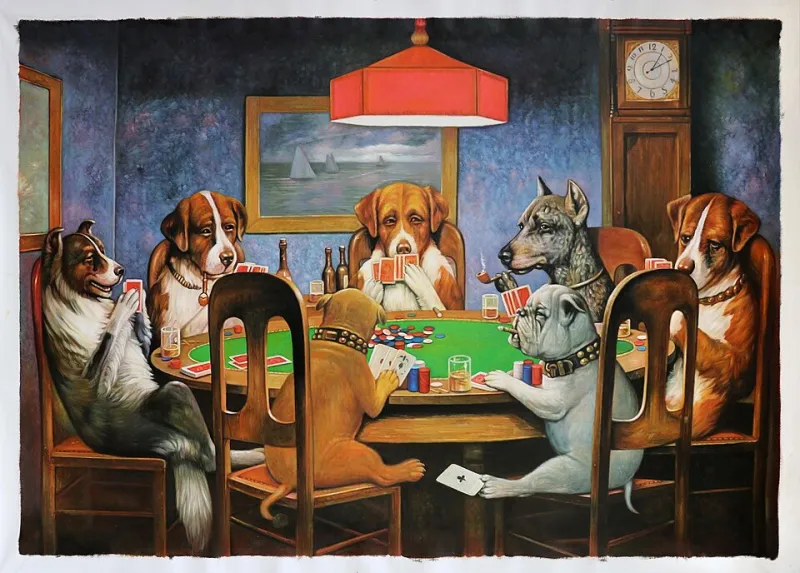
Photo: Cassius Marcellus Coolidge, Public domain, via Wikimedia Commons
There's a moment at any dog park — usually right around the time a golden retriever bolts across the field and triggers a full chain reaction of barking — where the whole place becomes something close to a percussion ensemble. It's chaotic, it's layered, it's got rhythm if you listen hard enough. And a small but passionate group of producers across the US has started listening very hard.
Field recorders in hand, these producers are showing up at off-leash parks from Prospect Park in Brooklyn to Griffith Park in LA, capturing hours of canine-driven soundscapes and turning them into electronic music that nobody asked for but apparently everyone needed. The results are weird, warm, and weirdly moving — tracks that carry the kind of organic energy that no synthesizer has ever quite nailed.
Why a Dog Park Sounds Like a Record Waiting to Happen
The sonic environment of a dog park is more complex than it gets credit for. You've got layered barking across a wide pitch range — chihuahuas riding high frequencies, German shepherds anchoring the low end. Collar tags create a constant metallic shimmer, almost like a hi-hat that never fully commits to a tempo. Tennis balls bounce off packed dirt and chain-link fences. Humans laugh, call out names, have conversations that drift in and out of earshot. Water splashes from communal bowls. Paws tear across gravel.
"It's basically a living, breathing drum machine," says Marcus Delray, a Chicago-based producer who goes by the handle Fetch.wav and has been building tracks from dog park field recordings for the past two years. "The first time I really listened back to a session, I was like — there's a kick pattern in here. There's a snare. There's a whole groove buried under all this chaos."
Delray's process involves recording two to three hour sessions, then spending days combing through the audio for usable moments. A single sharp bark, pitched down two octaves, becomes a kick. A cluster of jingles gets time-stretched into a shimmering pad. The bounce of a rubber ball, layered four times and run through a reverb tail, turns into something that sounds uncannily close to a rimshot.
Wholesomeness as Texture
Here's the thing nobody in underground production really talks about: most experimental music is built from tension. Industrial clang, urban grit, distorted frequencies — there's an anxiety baked into a lot of the sonic material producers reach for. Dog parks are the opposite of that. They're spaces of uncomplicated joy, and when you sample them, that emotional signature doesn't disappear. It gets embedded in the music.
Producer and sound designer Kira Osei, who operates out of Portland, Oregon, describes it as "emotional metadata."
"When you sample something, you're not just capturing the sound — you're capturing the context," she explains. "And dog parks carry this very specific energy. Nobody's stressed there. Dogs are happy, people are happy. That gets into the music in ways that are hard to explain but really easy to feel."
Osei's recent EP, Off-Leash, leans fully into that warmth. Built almost entirely from recordings made at Portland's Chimney Park dog area, the project layers canine field recordings under minimal house structures — slow-rolling bass lines, open hats, sparse chord stabs. The effect is disarmingly gentle without ever going soft. It's electronic music you could play at a rooftop party and also, somehow, at a Sunday morning kitchen hangout.
The EP has been circulating in producer communities on Reddit and Discord, where the response has been a mix of genuine admiration and confused delight. "I don't know why this works but it absolutely does" is basically the consensus.
The Nature-Adjacent Sweet Spot
There's a meaningful distinction between sampling a dog park and sampling, say, a deep forest or a mountain stream. Pure wilderness recordings have their own appeal, and ambient producers have been working with them for decades. But dog parks exist in a different category — they're nature-adjacent, urban-inflected spaces where human and animal energy collide in a very specific, very American way.
"A forest is beautiful but it doesn't have rhythm the same way," says Delray. "A dog park has rhythm because there are dogs reacting to each other, people reacting to dogs. It's call and response. It's got structure."
That urban-nature hybrid quality also makes the recordings feel accessible in a way that pure field recordings sometimes don't. There's something familiar about the soundscape — most people in the US have either been to a dog park or lived near one. That recognition creates an immediate emotional hook that producers can build on.
DJ and producer Theo Bassett (yes, that's actually his name, and yes, he owns a basset hound) has been experimenting with dog park samples as a way to make his experimental club tracks feel more approachable. "I make music that's pretty out there," he admits. "Weird time signatures, heavy processing, stuff that can feel cold or cerebral. Adding dog park textures underneath warms the whole thing up. It's like putting a fireplace in a brutalist building."
The Recording Setup
For producers curious about trying this at home — or at their nearest dog park — the barrier to entry is surprisingly low. Most of the producers in this space are working with mid-range field recorders like the Zoom H5 or the Tascam DR-40X, paired with a decent stereo microphone. Placement matters: positioning the recorder near the center of the park captures the full spatial spread of the soundscape, while getting closer to the fence line isolates the metallic jingle textures.
Osei recommends going during peak hours — typically weekend mornings between 9am and 11am — when the park is busy enough to generate layered audio but not so chaotic that everything becomes mud. "You want overlap but you also want moments of clarity," she says. "That's where your usable samples live."
One practical note: always let park-goers know what you're doing. Most people, Delray says, are immediately charmed by the concept. "I tell them I'm making music from dog park sounds and they're like — wait, really? That's the coolest thing I've ever heard. Then they try to get their dog to bark on command, which never works, but it's very cute."
The Vibe Economy
There's a broader cultural conversation happening right now about what kinds of emotions electronic music is allowed to carry. For a long time, "underground" implicitly meant dark, intense, confrontational. But producers like Delray, Osei, and Bassett are part of a growing movement that treats warmth and joy as equally valid — and equally sophisticated — emotional territories.
Dog park music, if we're going to call it that, sits right at the center of that shift. It's not naive. It's not background music. It's just built from a different kind of raw material, one that carries a different emotional charge. And in a moment when a lot of people are exhausted by content that demands tension and anxiety, a track that genuinely makes you feel like a golden retriever just found its favorite ball might be exactly the kind of sonic reset the underground needs.
Fetch.wav's next project drops this fall. He's already scouting locations.