Wheels, Concrete, and Pure Chaos: The Producers Finding Their Sound at the Skate Park
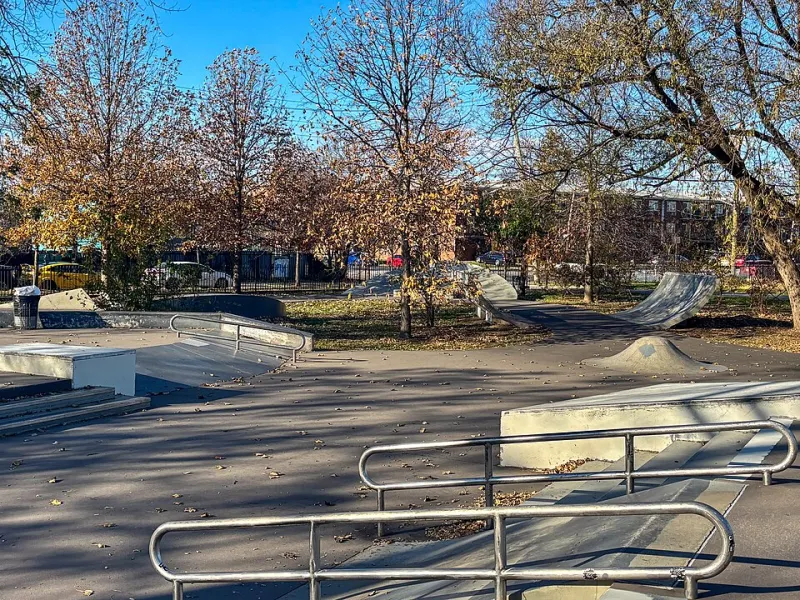
Photo: JAMMIN8905!, CC BY-SA 4.0, via Wikimedia Commons
There's a moment at any busy skate park — maybe it's a Sunday afternoon at Stoner Plaza in LA or a packed session at Burnside in Portland — where if you close your eyes and just listen, the whole place starts to sound like a drum machine that never quite locks to a grid. Polyrhythmic, gritty, alive. Wheels spinning up to speed, then that sharp crack of a board slapping concrete on a failed trick, then the hollow thunder of someone dropping into a bowl. Layered under it all, the low-frequency hum of urethane rolling across rough aggregate.
Producers are hearing it too. And more and more of them are showing up with field recorders, contact mics, and a willingness to sit in the middle of all that controlled mayhem just to capture what's happening.
The Skate Park as a Living Instrument
If you've spent any time reading about experimental production, you already know the field recording world has been pushing into stranger and stranger corners. Subway tunnels, hospital ICUs, storm cells — nothing is off limits if it carries texture and rhythm. But the skate park has a specific quality that sets it apart from most location recording environments: it's inherently percussive, and the percussion is performed by people who've spent years developing timing.
Skaters aren't musicians, but they operate on rhythm. The run-up, the pop, the landing — there's a cadence baked into every trick. When you record a busy park, you're not capturing random noise. You're capturing layered rhythmic decisions made by dozens of people at once, none of whom are coordinating with each other. That tension between intention and chaos is exactly the kind of raw material that experimental producers dream about.
Producers who've worked in these environments describe the concrete bowl in particular as a kind of natural reverb chamber. The curved walls and hard surfaces create reflections that a digital reverb plugin just can't fake. Sounds that hit the inside of a bowl come back transformed — smeared, widened, with a tail that feels geological rather than electronic.
What's Actually Getting Sampled
So what are producers actually walking away with after a session at the park? The list is more varied than you might expect.
Wheel roll textures are a big one. The sound of urethane wheels on smooth concrete versus rough concrete versus the painted surface of a ledge are three completely different sonic events. Recorded close with a contact mic attached directly to the concrete, the roll becomes this dense, almost white-noise-adjacent texture that works beautifully as a high-frequency bed in a mix.
Board impacts — the pop of a kickflip, the slam of a bail, the clack of trucks hitting a rail — function almost like snare and tom hits when pitched and processed. Stretch one of those impacts out with time-stretching tools and it becomes something genuinely alien. Compress it hard and it punches like a 808 clap.
Transition sounds — the specific low rumble of a skater dropping into a half-pipe or a bowl — carry a kind of bass frequency that's hard to engineer artificially. It's partly the impact, partly the resonance of the structure itself. Producers who've recorded it describe it as something between a kick drum and a sub bass hit, sitting in a frequency range that just sits in a mix without fighting anything else.
And then there's the ambient layer — the crowd, the chatter, the distant music someone's playing from a Bluetooth speaker, the occasional shout when a trick lands clean. That stuff gets used as texture, atmosphere, the connective tissue between harder rhythmic elements.
Why Skate Culture and Experimental Music Are a Natural Fit
This isn't just a technical story about interesting sounds. There's a cultural alignment here that makes a lot of sense once you think about it.
Skate culture and underground electronic music have been running parallel for decades. Both communities share a DIY ethic, a suspicion of mainstream gatekeepers, and a deep appreciation for technical skill that most outsiders can't fully read. The way skaters talk about lines and spots mirrors the way producers talk about arrangement and sound design — obsessive, specific, constantly iterating.
There's also a shared relationship with urban space. Skaters have always treated the city as raw material, finding rhythm and possibility in architecture that was never designed for it. Producers doing location recording are doing the same thing — hearing the city as an instrument rather than a backdrop. It makes sense that they'd eventually find each other at the park.
Some producers have taken this overlap further, building entire projects around the skate world. We're talking about albums where the liner notes credit specific parks and specific skaters alongside the usual production credits. The sample isn't just an aesthetic choice — it's a statement about where the music comes from and who it's connected to.
The Technical Side of Recording at a Park
If you're thinking about heading out with a recorder, there are some practical realities worth knowing.
First, most public skate parks are genuinely loud environments. You'll need a decent field recorder — something in the Zoom H5 or Tascam DR-40X range at minimum — and you'll want a variety of mic configurations. A stereo pair for wide ambient capture, a shotgun for directional close recording, and contact mics for surface-attached texture work will cover most scenarios.
Second, time of day matters enormously. Early morning sessions at a park, before the crowd builds, give you cleaner individual sounds with less bleed. Peak afternoon hours give you that dense, layered ambient texture but make it harder to isolate specific elements. A lot of producers do both — come back at different times and treat them as separate recording environments.
Third — and this one matters — respect the space. Skaters have a culture and a community at these parks. Showing up with gear and acting like the park is your personal studio doesn't land well. The producers who've had the best experiences at these spots talk about showing up consistently, getting to know people, and being transparent about what they're doing. In some cases, that's led to actual collaboration — skaters contributing to tracks, or producers building music specifically for video projects.
The Remix Is Already Happening
What's exciting about this moment is that the feedback loop is already spinning. Tracks built from skate park recordings are getting used in skate videos. Skate videos are introducing those sounds to audiences who then seek out the music. The culture is sampling itself and producing something new in the process.
That's the real story here. It's not just that the skate park is a cool place to find unusual sounds — it's that the relationship between these two communities is starting to produce something genuinely generative. The concrete bowl isn't just a recording location. It's a collaborator.
And honestly, for producers who've been staring at the same sample libraries and plugin presets for years, that kind of collaboration — unpredictable, physical, rooted in a specific place and culture — might be exactly what the next record needs.