Level P2: The Experimental Producers Turning Parking Garages Into Dystopian Sound Labs
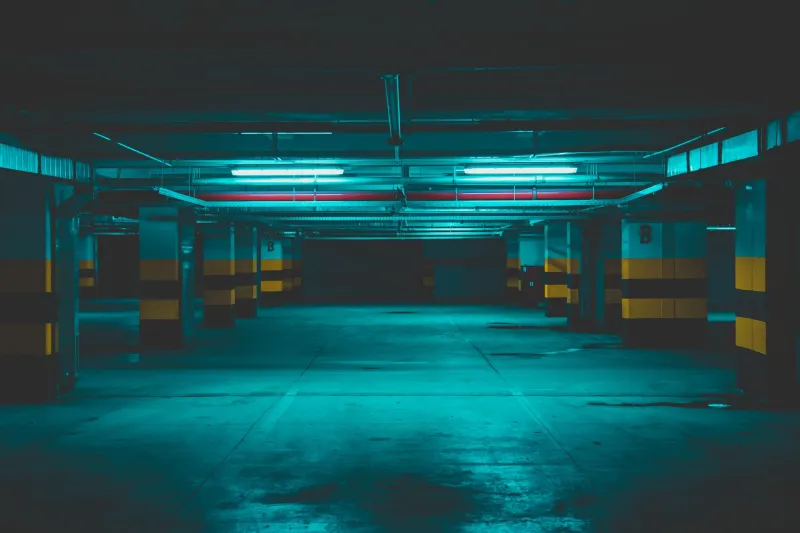
The elevator doors open on P2 and the sound hits you before anything else. It's not loud, exactly — it's present. A low, sustained resonance that seems to come from everywhere and nowhere simultaneously. Footsteps that multiply. The distant squeal of tires two levels up that arrives as something almost musical. The drip of water from a concrete seam that echoes so long it feels like a conversation.
This is what experimental producers have been quietly losing their minds over for the past few years. The multilevel underground parking garage — mundane, utilitarian, slightly threatening — turns out to be one of the most acoustically extraordinary spaces in the built American environment. And a growing underground of industrial, experimental, and ambient artists has figured out how to turn that into some of the most claustrophobic, immersive electronic music being made right now.
The Physics of the Parking Garage
Before getting into the music, it's worth understanding why these structures sound the way they do — because the acoustic properties of a parking garage aren't accidental. They're the direct result of design choices made for entirely practical reasons that happen to create an extraordinary sonic environment.
Poured concrete is one of the most reflective building materials in existence. Unlike the acoustic tile, carpet, and soft furnishings that absorb sound energy in most interior spaces, bare concrete bounces almost everything back. In a space with parallel concrete walls, floor, and ceiling — which describes every level of a typical parking structure — sound reflects repeatedly, creating a reverb tail that can stretch to several seconds depending on the size of the space.
More interestingly, the irregular geometry of a parking garage — the support columns, the ramps, the half-walls between levels, the low ceiling height relative to the floor area — creates a reverb that isn't smooth or uniform. Different frequencies decay at different rates. High-end detail gets smeared and diffused. Low frequencies build up in corners and alcoves into something close to a physical sensation. The result is a reverb profile that no plugin has fully replicated, because no plugin is modeling the specific chaos of a real concrete structure.
"Every garage is different," says Travis Lund, a Minneapolis-based producer who makes experimental electronic music under the name Null Deck. "I've recorded in maybe fifteen or twenty different structures at this point, and each one has its own character. Some are bright and harsh. Some are dark and deep. The older ones, especially the ones with lower ceilings and more columns, tend to have this incredible mid-range buildup that makes everything sound massive."
What Producers Are Actually Recording
The sound design possibilities inside a parking garage are broader than most people would expect. Lund's process involves extended field recording sessions — often three to four hours in a single structure — capturing everything from deliberate acoustic tests (clapping, shouting, striking columns with a rubber mallet) to purely ambient material (the HVAC system, the emergency lighting fixtures, the distant sounds of the street filtering in through the entrance ramp).
Tire sounds are a major category on their own. The squeal of a car turning on polished concrete — especially on the curved ramps that connect levels — produces a tone that's somewhere between a synthesizer pitch bend and a human scream. Recorded and processed, it becomes one of the most emotionally intense sounds in experimental music. "I have an entire sample folder that's just tire squeals from different garages," says Lund. "Pitched, layered, reversed. That folder has been on probably a dozen tracks at this point."
Footsteps on concrete, particularly in stairwells, offer a different kind of material — more rhythmic, more human-scaled. The natural reverb of a parking stairwell turns ordinary walking into something that sounds choreographed. Producers use these recordings both as literal percussion elements and as textural layers that add a sense of physical space and movement to otherwise purely electronic tracks.
Then there are the structural sounds — the groan of a concrete beam settling, the vibration of a ventilation duct, the metallic clank of an elevator door — that exist at the intersection of industrial noise and found percussion. These are the sounds that give the music its specific character: urban, mechanical, slightly ominous.
The Claustrophobia Is the Point
If there's a unifying aesthetic principle in this corner of experimental production, it's intentional claustrophobia. These producers aren't trying to make listeners comfortable. They're trying to make them feel something specific — the particular psychological state of being in a space that was designed for machines, not people.
"A parking garage is built for cars," says Yolanda Cruz, a Los Angeles-based sound artist who incorporates parking garage recordings into installation work and electronic releases. "When you're in one without a car, you feel that. The scale is wrong for a human body. The ceiling is too low. The lanes are too wide. Everything about the space tells you that you're secondary to the vehicles that are supposed to be there. That feeling comes through in the recordings."
Cruz's work leans harder into the abstract end of the spectrum, using garage recordings as the primary compositional material rather than layering them under conventional electronic production. Her approach involves extensive editing — finding the moments where the acoustic environment creates something that sounds almost composed, then building around those moments rather than imposing structure on top of them.
"Sometimes the garage just plays something," she says. "A car comes in, the reverb builds, there's a moment of resonance where everything lines up — and then it decays. That's a musical event. My job is to recognize it when it happens and capture it."
Logistics and Ethics of Recording in These Spaces
The practical reality of recording in parking garages is complicated. Some structures are publicly accessible, particularly open-air municipal garages attached to parks or civic buildings. Others are private property, and recording in them without permission is technically trespassing — something producers in this community acknowledge and navigate with varying levels of caution.
The more established artists tend to seek formal permission, often framing their work as field recording or sound art rather than music production, which tends to get a warmer reception from property managers. Some have established ongoing relationships with specific garage operators, particularly in cities with active experimental music scenes.
"I've had mostly good experiences when I've been upfront about what I'm doing," says Lund. "Most security guards are curious rather than hostile once they understand it's not vandalism. A few have actually started pointing out spots in their garages that they think sound particularly interesting. That's happened more than once."
The Sound of Infrastructure
Zoom out far enough and this trend connects to something larger happening in experimental and electronic music — a growing interest in the sonic character of infrastructure. Not the natural world, not the concert hall, but the built environment that most people move through without listening to.
Parking garages, phone switching stations, subway systems, power substations — these are the spaces that keep American cities running, and they're acoustically extraordinary precisely because nobody designed them to be heard. The sounds they produce are honest in a way that designed sonic environments can never quite be.
The producers working in this space are essentially field recordists with a dystopian bent, treating the American built environment as an instrument that's been playing the whole time — just waiting for someone to finally listen.
The elevator's going down. Hit record.