Open Wide: The Experimental Producers Mining Dental Offices for Their Most Unsettling Sounds Yet
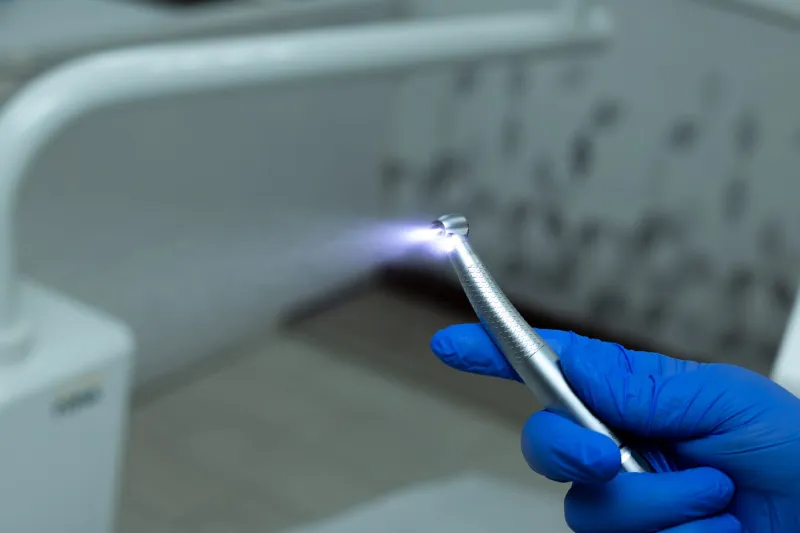
There's a particular kind of dread that hits the moment you recline in a dental chair. The overhead light blinds you. Somewhere behind you, a machine hums. Then comes the whir — that high-pitched, mechanical shriek that somehow manages to vibrate in your teeth before the drill even touches enamel. For most people, that's a reason to white-knuckle the armrests. For a specific breed of experimental producer, it's a reason to hit record.
Welcome to one of the strangest and most fertile new frontiers in sound design: the American dental office.
Why the Dentist's Office Sounds Like a Dystopian Fever Dream
Strip away the context — the anxiety, the antiseptic smell, the laminated posters about flossing — and a dental office is genuinely one of the more sonically complex spaces most Americans visit on a semi-regular basis. You've got mechanical textures layered on top of each other in ways that most studios can't manufacture. The turbine whine of a high-speed handpiece sits somewhere between a synthesizer oscillator and a feedback loop. The suction wand produces this wet, rhythmic pull that lands somewhere between a kick drum and a vocal chop. The air compressor in the back room pulses like a kick on a 4/4 grid, except slightly off — always slightly off.
And then there's the waiting room. God, the waiting room.
Every dental office in the country seems to pipe in the same genre of music: a mid-tempo, de-clawed soft rock that's been compressed within an inch of its life and filtered through speakers that haven't been replaced since 2003. It's ambient by accident. It's lo-fi by neglect. And when you layer it underneath glitch textures and sub-bass, it becomes something genuinely haunting.
The Producers Paying Attention
A loose network of experimental and noise-adjacent producers — many of them working in the broader glitch, industrial ambient, and hyperpop-adjacent spaces — have started treating dental offices the way field recorders treat rain forests. They're showing up with portable recorders, sometimes with permission, sometimes just relying on whatever their phone mic can pick up while they're actually getting a cleaning.
The results are landing in tracks that feel clinical and claustrophobic in the best possible way. Think early Arca, or the more abrasive corners of SOPHIE's catalog, or the kind of stuff you'd find on a Bandcamp page with a cover that's just a close-up of a latex glove. The dental office aesthetic — sterile, procedural, faintly threatening — maps perfectly onto a strain of experimental music that's been chasing that exact vibe for years.
What makes it work isn't just the individual sounds. It's the layering. A dentist's office operates in overlapping mechanical cycles, and when you start isolating those cycles and pitching them around, you end up with polyrhythms that would take hours to program from scratch in a DAW. The drill doesn't just whir — it changes pitch depending on pressure and material. The suction doesn't just pull — it stutters, catches, releases. These are dynamic, responsive sounds that carry genuine texture.
The Nitrous Factor
Okay, we'd be leaving something on the table if we didn't acknowledge the elephant in the room — or more accurately, the gas in the mask. Nitrous oxide has a long, storied relationship with altered perception, and there's a real argument to be made that the particular headspace of a nitrous-assisted dental procedure produces one of the stranger listening environments a human being can occupy. Sounds stretch. Distances collapse. The overhead light becomes abstract.
More than a few producers have pointed to that altered-state listening experience as part of what makes dental audio so compelling to work with. When you're processing sounds that were originally received through a chemically softened nervous system, you're already halfway to something psychedelic. The challenge is translating that into a track that communicates the same quality of unease to a listener who is, presumably, fully conscious and sitting in front of studio monitors.
Some producers get there by pitching sounds way down and adding reverb that feels like it's coming from inside a wall. Others chop the suction into stutter edits that make the whole track feel like it's breathing wrong. There's no single formula — which is kind of the point.
Sampling Ethics and the Consent Question
Here's where things get a little thorny. Dental offices are medical environments, and they operate under specific rules about recording, privacy, and patient confidentiality. You can't just roll in with a field recorder and start capturing audio without navigating some real ethical and legal territory — especially if other patients are audible in the background.
The producers doing this thoughtfully are either working directly with dental offices that are genuinely curious about the project, recording only in spaces where they're the sole patient, or focusing on mechanical and ambient sounds that don't involve any human voices other than their own. A handful of producers have reached out to dental schools — places like NYU College of Dentistry or the University of Pacific Arthur A. Dugoni School of Dentistry — where the experimental, educational vibe has made staff more open to unconventional recording sessions.
The ones cutting corners are, predictably, getting less interesting results. A recording that's ethically messy tends to be sonically messy in ways that don't serve the track. The discipline of doing it right — getting access, isolating specific equipment sounds, recording clean — produces better raw material.
What It Sounds Like in Practice
Picture a track that opens with the muffled thud of a waiting room door, followed by the distant, underwater warble of a soft rock ballad filtered through cheap speakers. A compressor kicks in — low, rhythmic, slightly uneven. Then the drill enters, pitched down two octaves and stretched until it sounds like a synthesizer that's melting. The suction comes in on the offbeat, wet and percussive. By the time any kind of bass drops, the listener is already inside a specific emotional space: clinical, anxious, oddly transfixed.
That's the move. It's not horror music, exactly. It's not ambient, exactly. It lives in the gap between those two things, and the dental office provides the raw material to get there in a way that synthesized sounds alone rarely achieve.
The Bigger Picture
The dental office as sample source is part of a broader shift in how experimental producers are thinking about location. The most interesting textural work happening right now isn't being built from drum machines and synth patches — it's being assembled from spaces that carry emotional weight before a single note is played. A hospital. A laundromat. A subway platform at 2 a.m. These are places that already have a vibe, and that vibe is transferable.
The dental office hits differently because the emotional weight is so specific and so universal. Almost every American has sat in that chair. Almost every American has felt that particular cocktail of helplessness and fluorescent-lit dread. When a producer captures that environment and remixes it into something you can move to — or at least sit very still to — they're doing something genuinely interesting with shared cultural memory.
Open wide. This one's going to sting a little.